
Blog
Small Business Bookkeeping Services: The Complete 2026 Guide

Accurate financial records form the foundation of every successful small business. Yet many owners spend countless hours wrestling with receipts, bank reconciliations, and tax deadlines instead of growing their companies. Professional small business bookkeeping services solve this problem by delivering accurate, timely, and compliant financial data without the cost of a full-time in-house team.
In 2026, the global bookkeeping services market continues its steady expansion. Industry reports place the overall bookkeeping services market at approximately $50.48 billion in 2025, rising to $53.68 billion in 2026 at a compound annual growth rate of about 6.3 percent. Projections show further growth toward $69.26 billion by 2030. The segment focused specifically on small businesses shows even stronger momentum in several analyses, with estimates around $26.5 billion in 2025 and projected growth exceeding 8 percent CAGR through the early 2030s in certain reports. North America remains the largest regional market, driven by high rates of outsourcing among U.S. small businesses—roughly 68 percent of U.S. small businesses outsource at least some bookkeeping tasks.
This comprehensive pillar page examines every critical aspect of small business bookkeeping services. You will find current market data, cost ranges, service models, technology trends, selection criteria, and practical advice drawn from 2025–2026 industry research. Whether you run a sole proprietorship, a growing LLC, or a multi-location operation, this guide helps you decide whether outsourcing makes financial sense and how to choose the right provider.
Why Small Businesses Need Professional Bookkeeping Services
Most small business owners wear many hats. Bookkeeping often becomes one of the least favorite. Research consistently shows that small business owners spend more than 80 hours per year on financial record-keeping tasks. That time carries a high opportunity cost. At even a modest $50–$100 per hour effective rate, the annual cost of do-it-yourself bookkeeping quickly exceeds the price of professional services.
Accurate books deliver several concrete benefits:
- Clear visibility into cash flow so you can make informed decisions about inventory, hiring, and expansion.
- Reduced risk of costly errors that trigger IRS notices or lender scrutiny.
- Preparedness for tax season, loan applications, or investor reviews.
- Compliance with sales tax, payroll, and industry-specific reporting requirements.
- Time freed for revenue-generating activities.
Approximately 70 percent of small businesses still operate without a dedicated accountant or bookkeeper. Many of those that do handle finances rely on the owner or a single overburdened employee. Outsourcing fills this gap efficiently.
Global and Regional Market Overview for Small Business Bookkeeping Services
The demand for bookkeeping services tracks closely with new business formation and regulatory complexity. In the United States alone, new business applications have remained elevated in recent years, creating a steady pipeline of companies that need foundational financial systems.
Key 2025–2026 market indicators include:
- Overall bookkeeping services market: $50.48 billion (2025) → $53.68 billion (2026).
- Projected growth to approximately $69 billion by 2030 at roughly 6.6 percent CAGR.
- Small-business-focused segments showing higher growth rates in multiple analyses (often 7–9 percent CAGR).
- SMEs accounting for more than half of market revenue in most global breakdowns.
- Cloud-based delivery models capturing the majority of new growth.
- High outsourcing rates among U.S. small businesses (around 68 percent).
North America leads in both absolute market size and adoption of outsourced and cloud solutions. Europe and Asia-Pacific follow, with Asia-Pacific showing faster percentage growth as digital transformation accelerates among SMEs in China, India, and Southeast Asia.
AI-driven automation and real-time reporting represent the strongest technology trends. Providers that combine human expertise with automated categorization, bank feeds, and exception handling deliver higher accuracy at lower cost per transaction.
Types of Small Business Bookkeeping Services Available in 2026
Providers typically organize offerings into several tiers and delivery models.
Basic Monthly Bookkeeping
Transaction categorization, bank and credit card reconciliation, monthly profit-and-loss and balance sheet statements. Suitable for freelancers and simple service businesses with under 100–150 transactions per month.
Full-Service Bookkeeping
Everything in basic packages plus accounts payable and receivable management, payroll coordination, sales tax tracking, and year-end tax package preparation.
Virtual / Cloud Bookkeeping
Remote teams working inside platforms such as QuickBooks Online, Xero, or FreshBooks. Clients upload documents via mobile apps or portals; bookkeepers maintain the books in real time.
Industry-Specialized Services
Ecommerce, construction, healthcare, professional services, restaurants, and nonprofits often require specialized chart-of-accounts structures, inventory tracking, or compliance reporting.
Controller-Level or Fractional CFO Support
Higher-tier services that include cash-flow forecasting, KPI dashboards, and strategic financial guidance in addition to pure bookkeeping.
Most modern providers now offer fixed monthly pricing rather than pure hourly billing. Fixed fees create predictability for both client and provider.
How Much Do Small Business Bookkeeping Services Cost in 2026?
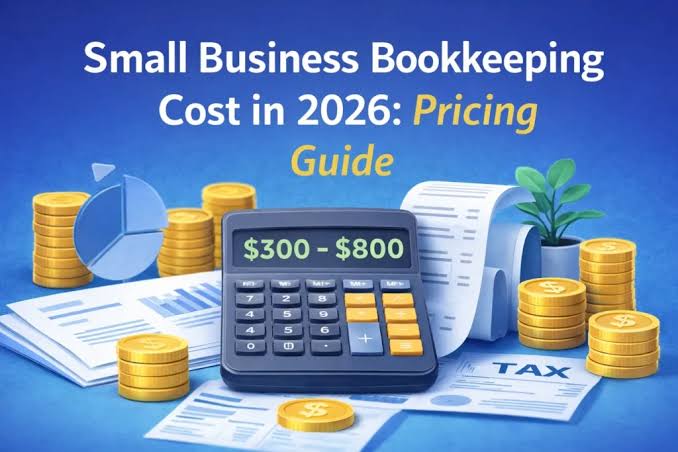
Pricing varies primarily by transaction volume, complexity, and level of service rather than pure revenue size. Current 2026 ranges observed across major providers and industry benchmarks include:
| Business Profile | Typical Monthly Transactions | Monthly Cost Range |
|---|---|---|
| Sole proprietor / freelancer | 0–50 | $150–$400 |
| Simple small business | 50–150 | $300–$650 |
| Complex small business | 150–400 | $500–$1,200 |
| Growing / multi-entity | 400–1,000+ | $900–$2,500+ |
Hourly rates for independent bookkeepers generally fall between $40 and $100, with experienced certified bookkeepers at the higher end. Full-time in-house bookkeepers cost significantly more when salary, benefits, software, and management overhead are included—often $3,200–$4,500 per month or higher.
Outsourced services frequently deliver better value because providers spread software, training, and quality-control costs across many clients. Many firms also include year-end tax preparation packages or discounted rates for ongoing relationships.
Additional factors that influence price:
- Number of bank and credit accounts
- Inventory or job-costing requirements
- Multi-state sales tax complexity
- Payroll frequency and employee count
- Need for custom reporting or integrations
Key Benefits of Outsourcing Bookkeeping for Small Businesses
Outsourcing produces measurable advantages beyond simple time savings.
Accuracy and Compliance
Professional bookkeepers maintain higher accuracy rates and stay current with tax law and reporting changes. Error rates drop substantially compared with owner-managed books.
Scalability
As transaction volume grows, the service scales without the delay and cost of hiring and training new staff.
Technology Access
Clients gain the benefit of enterprise-grade software, bank feeds, optical character recognition for receipts, and AI categorization tools that individual owners rarely implement fully on their own.
Cash Flow Visibility
Monthly or real-time reports highlight slow-paying customers, rising expenses, and seasonal patterns early enough to take action.
Tax Readiness
Clean books reduce preparation time and the risk of penalties or audits. Many services deliver a complete year-end package ready for the tax preparer.
Focus on Core Business
Owners report reclaiming 10–20 hours per month that can be redirected to sales, product development, or customer service.
How to Choose the Right Small Business Bookkeeping Service
Selecting a provider requires careful evaluation of several factors.
- Software Compatibility – Confirm the firm works in the platform you prefer (QuickBooks Online, Xero, FreshBooks, Wave, etc.) or is willing to migrate your data.
- Service Scope and Communication – Clarify exactly what is included each month and how often you will receive reports and have live discussions.
- Security and Data Protection – Look for SOC 2 compliance, encrypted portals, and clear data-handling policies.
- Experience with Your Industry – Specialized knowledge reduces setup time and improves report relevance.
- Pricing Transparency – Prefer fixed monthly fees with clearly defined transaction limits and add-on pricing.
- Scalability and Support Team – Ask who handles your books day-to-day and what happens during vacations or high-volume periods.
- Reviews and References – Examine independent reviews and request client references of similar size and industry.
- Onboarding Process – A structured onboarding with chart-of-accounts review and historical cleanup signals professionalism.
Many reputable firms offer a discovery call or short trial period so you can evaluate fit before committing.
Technology Trends Shaping Small Business Bookkeeping in 2026
Several technologies have moved from emerging to mainstream:
- AI Categorization and Anomaly Detection – Machine learning models automatically code transactions and flag unusual activity.
- Real-Time Bank Feeds and Continuous Reconciliation – Daily rather than monthly closes become practical.
- Mobile Receipt Capture – Owners photograph receipts; software extracts data and matches to transactions.
- Integrated Payroll and Tax Modules – Seamless flow from timesheets to tax filings reduces double entry.
- Client Portals and Dashboards – Self-service access to current financials and document upload.
- API Integrations – Connections to ecommerce platforms, payment processors, and inventory systems eliminate manual imports.
Providers that invest in these tools deliver higher accuracy and faster turnaround at competitive prices.
Common Challenges and How Professional Services Solve Them
Small businesses frequently encounter:
- Mixed personal and business expenses
- Missing or incomplete receipts
- Delayed reconciliations that hide cash-flow problems
- Inconsistent categorization that distorts profit analysis
- Last-minute tax-season scrambles
Professional bookkeeping services address these issues through structured processes, dedicated portals, regular review cycles, and clear communication protocols. Many firms also provide light training so owners improve their own document-handling habits.
Getting Started with Small Business Bookkeeping Services
The typical onboarding sequence looks like this:
- Initial consultation to understand business structure, transaction volume, and goals.
- Software setup or migration and chart-of-accounts design.
- Historical cleanup (if needed) for the current or prior year.
- Establishment of document submission routines (bank feeds, receipt apps, shared folders).
- First month of live bookkeeping and report delivery.
- Ongoing monthly cycle with scheduled review calls.
Most providers can complete basic setup within one to two weeks once documents and access credentials are supplied.
Frequently Asked Questions About Small Business Bookkeeping Services
How much should a small business budget for bookkeeping?
Most simple operations spend $300–$700 per month. More complex or higher-volume businesses typically range from $800 to $2,000+.
Is outsourcing cheaper than hiring an employee?
In nearly all cases yes. Fully loaded cost of an in-house bookkeeper (salary, benefits, software, management time) far exceeds outsourced monthly fees for equivalent work.
Do I still need a CPA if I have a bookkeeper?
Yes. Bookkeepers maintain the records; CPAs provide tax strategy, representation, and higher-level advisory work. Clean books make the CPA’s job faster and less expensive.
What software do most small business bookkeeping services use?
QuickBooks Online remains the most common platform in the United States, followed by Xero and several specialized tools.
How quickly can I see results after switching?
Many clients notice improved clarity within the first 30–60 days once historical cleanup is complete and monthly processes stabilize.
Can bookkeeping services handle multi-state or international operations?
Specialized providers can. Confirm experience with sales tax nexus, multi-currency, and relevant compliance requirements.
Conclusion: Investing in Financial Clarity
Professional small business bookkeeping services have evolved from a simple record-keeping function into a strategic advantage. In a market that continues to grow at a healthy pace—driven by new business formation, regulatory demands, and digital tools—the decision to outsource is increasingly straightforward for owners who value their time and accurate data.
By choosing a reputable provider, defining clear scope, and maintaining consistent document flow, small businesses gain reliable financial insights at a predictable cost. The result is better decision-making, reduced stress during tax season, and more hours available to focus on what the business does best.
Whether you are just starting or scaling past the point where owner-managed books remain practical, the right bookkeeping partnership delivers lasting value.